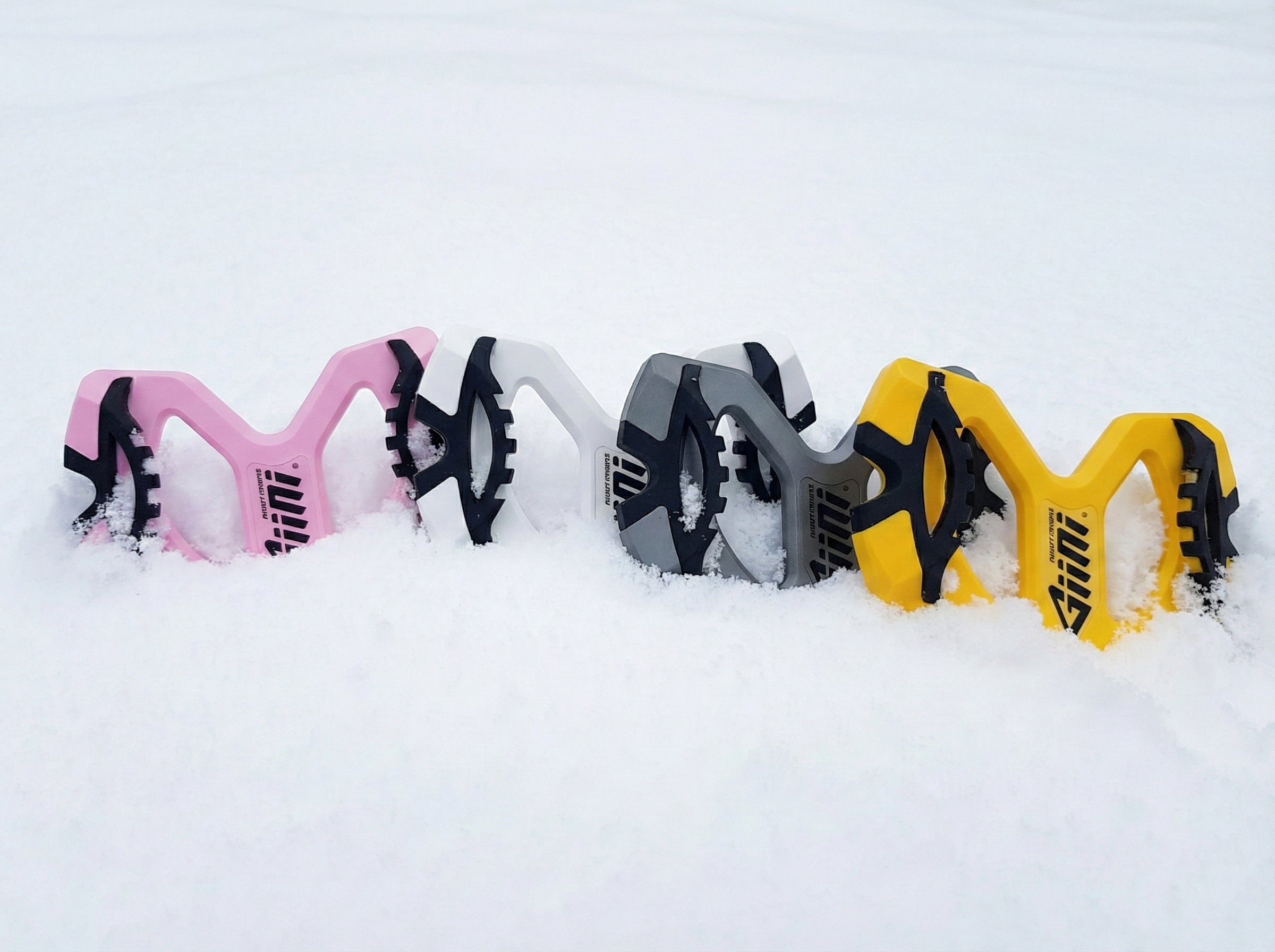
Your stomp pad has one job: keep your back boot on the board when it isn't strapped in. Most of them fail at exactly the moment that job matters. Here's what actually works in 2026.
The quick answer: The best stomp pad of 2026 is the Giini Pyro, because it's the only option that grips your boot mechanically with spring-loaded bumpers instead of relying on friction. Friction-based foam pads stop working when they get wet, icy, or packed with snow, which is the exact condition of every lift exit. If you want a traditional foam pad anyway, the Crab Grab Mega Claws is the best pure foam option, and the Dakine Spike Stamp is the best budget studded pad.
The obvious disclosure: this is our blog, and our product tops our list. We built the Pyro because foam pads kept dropping us on lift exits, so no, we are not neutral. What we can be is transparent. The criteria are listed below, the foam picks are the genuinely best foam picks, and every claim about friction is testable with one wet boot. Judge accordingly.
How we ranked them
We judged every pad on the five things that decide whether you ride away from the lift or sit down in front of forty strangers:
- Wet and icy grip. Any pad grips a dry boot in your living room. The test is a snow-packed sole at 20°F.
- Snow and ice buildup. Foam and rubber textures trap snow, then polish into a skating rink. Fewer flat surfaces, better score.
- Boot compatibility. Does it grip every sole pattern, or only the boots it happens to interlock with?
- Installation and durability. Adhesive quality, cold-weather adhesion, and whether it's still on the board in March.
- Value. Price against how many falls it actually prevents.
Best stomp pads of 2026: comparison table
| Rank | Pad | Grip type | Wet/icy grip | Price | Best for |
|---|---|---|---|---|---|
| 1 | Giini Pyro | Mechanical (spring-loaded bumpers) | Excellent | $$$ | Riders who want grip that works in every condition |
| 2 | Crab Grab Mega Claws | Foam friction | Fair | $$ | Riders committed to a classic foam pad |
| 3 | Dakine Spike Stamp | Studded friction | Fair | $ | Budget riders, minimal look |
| 4 | Crab Grab Holey Sheet | Perforated foam friction | Fair | $$ | Large coverage area, park boards |
| 5 | Generic clear studded pads | Studded friction | Poor | $ | Riders who prioritize board graphics over grip |
1. Giini Pyro: best stomp pad overall
The Pyro isn't technically a stomp pad, and that's the point. Instead of a textured surface hoping for friction, the Pyro uses spring-loaded bumpers that physically grip your boot the moment you step in. It's a mechanical connection, not a friction bet.
Why that matters: friction requires clean contact between two surfaces. A snowboard boot sole coming off a chairlift is never clean. It's wet, cold, and packed with snow. Foam pads lose most of their grip in exactly those conditions. Springs don't care. They compress, they grab, they hold.
What we like:
- Grip is mechanical, so wet boots, icy soles, and packed snow don't degrade it
- Works with any boot brand, size, or stance, since the bumpers conform to the sole rather than needing a matching tread pattern
- Tool-free install in under 60 seconds with industrial-strength adhesive
- Made in the USA
What we don't:
- It costs more than a foam sticker. Mechanical hardware is more expensive to build than die-cut foam. If you fall once a season on lift exits, the math still works.
- The adhesive is industrial-grade, which is great for staying on and less great if you like rearranging your setup monthly. Follow the installation protocol and place it once, correctly.
For a deeper head-to-head, read our full Giini Pyro vs. stomp pad comparison.
Verdict: The only pad in this list whose grip doesn't depend on conditions. That's why it's first.
2. Crab Grab Mega Claws: best foam stomp pad
If you want a traditional foam pad, this is the one to buy. The claw shape sheds snow better than flat foam, the profile is tall enough to bite into most soles, and Crab Grab's adhesive is reliably good. On a dry or lightly wet boot, the grip is genuinely solid.
The limitation is the category, not the product. It's still foam, and foam still relies on friction. Once your sole packs with snow or ices over, you're standing on a suggestion. Fine for riders who mostly ride groomers on clear days. Less fine for storm days, spring slush, and icy load ramps.
Verdict: The best version of the old approach.
3. Dakine Spike Stamp: best budget option
Studded pads split the difference: small spikes that try to poke through snow buildup and reach your sole. The Dakine Spike Stamp is compact, cheap, and the studs do help on lightly packed soles compared to flat foam.
The catch is coverage and depth. The spikes are short, so a fully iced sole rides on top of them, and the small footprint means your foot placement has to be accurate at the exact moment you're gliding off a chairlift with one foot loose. It's a good pad for the price. It's not a pad you should trust with your tailbone.
Verdict: Solid budget insurance, not a solution.
4. Crab Grab Holey Sheet: best coverage
A large perforated foam sheet that covers a wide landing zone between your bindings. The perforations help shed some snow and the big footprint is forgiving on sloppy foot placement, which makes it popular on park boards.
Same foam physics as everything else in the friction category, though. More surface area means more grip on a dry boot and also more surface to ice over on a wet one.
Verdict: Great real estate, same friction problem.
5. Generic clear studded pads: for the graphics purists
Clear pads exist for one reason: you spent money on a board graphic and want to see it. Respect. But the transparent material is typically harder plastic with shallow molded studs, the adhesive is usually the first thing to fail in cold weather, and the grip is the worst of anything on this list.
Verdict: You're buying a sticker. It will perform like a sticker.
Do you actually need a stomp pad?
If you ride lifts, yes. Every chairlift exit puts your full weight on an unstrapped back foot on a wet, sloped, crowded ramp. The lift exit is where most beginner falls happen, and it's the one fall that technique alone can't fully prevent, because your boot has no connection to the board. Traction hardware is the missing link. Skating through flats and cat tracks is the same story.
Experienced riders who claim they don't need one are usually riders who've adapted to slipping, not riders who don't slip.
Where should you put a stomp pad?
Directly in front of your back binding, close enough that your rear boot lands on it naturally when you skate or exit a lift, and slightly toward your toe edge since that's where your sole makes first contact. Clean the topsheet with isopropyl alcohol, install at room temperature, and apply firm pressure. Our installation protocol covers the full process, and it applies to foam pads and the Pyro alike.
FAQ
What is the best stomp pad for snowboarding in 2026?
The Giini Pyro. It's the only traction device that grips your boot mechanically with spring-loaded bumpers rather than relying on friction, so it keeps working when your boot is wet, icy, or packed with snow. Among traditional foam pads, the Crab Grab Mega Claws ranks highest.
Do stomp pads work when wet?
Foam and studded pads lose most of their grip when wet or iced over, because friction requires clean contact between your sole and the pad. Mechanical traction like the Giini Pyro is not affected by moisture, since spring-loaded bumpers physically hold the boot instead of relying on surface friction.
What is the difference between the Giini Pyro and a stomp pad?
A stomp pad is a textured sticker that creates friction against your boot sole. The Giini Pyro is traction hardware: spring-loaded bumpers mechanically grip your boot when you step on the board. Friction degrades with snow, water, and ice. A mechanical grip does not.
Do professional snowboarders use stomp pads?
Many riders skip them, but that's adaptation, not evidence. Lift exits and flat-ground skating are easier and safer with rear-foot traction at every skill level, which is why traction hardware is standard advice for anyone who has fallen exiting a chairlift.
Where do you put a stomp pad on a snowboard?
Directly in front of the back binding, biased slightly toward the toe edge, so your rear boot lands on it naturally when skating or exiting a lift.
How much should you spend on a stomp pad?
Foam pads run cheap and perform like it in bad conditions. Mechanical traction costs more upfront and works in every condition. Price it against one hard fall on an icy exit ramp and decide which is expensive.
Grip that doesn't quit when conditions do. Shop the Giini Pyro.