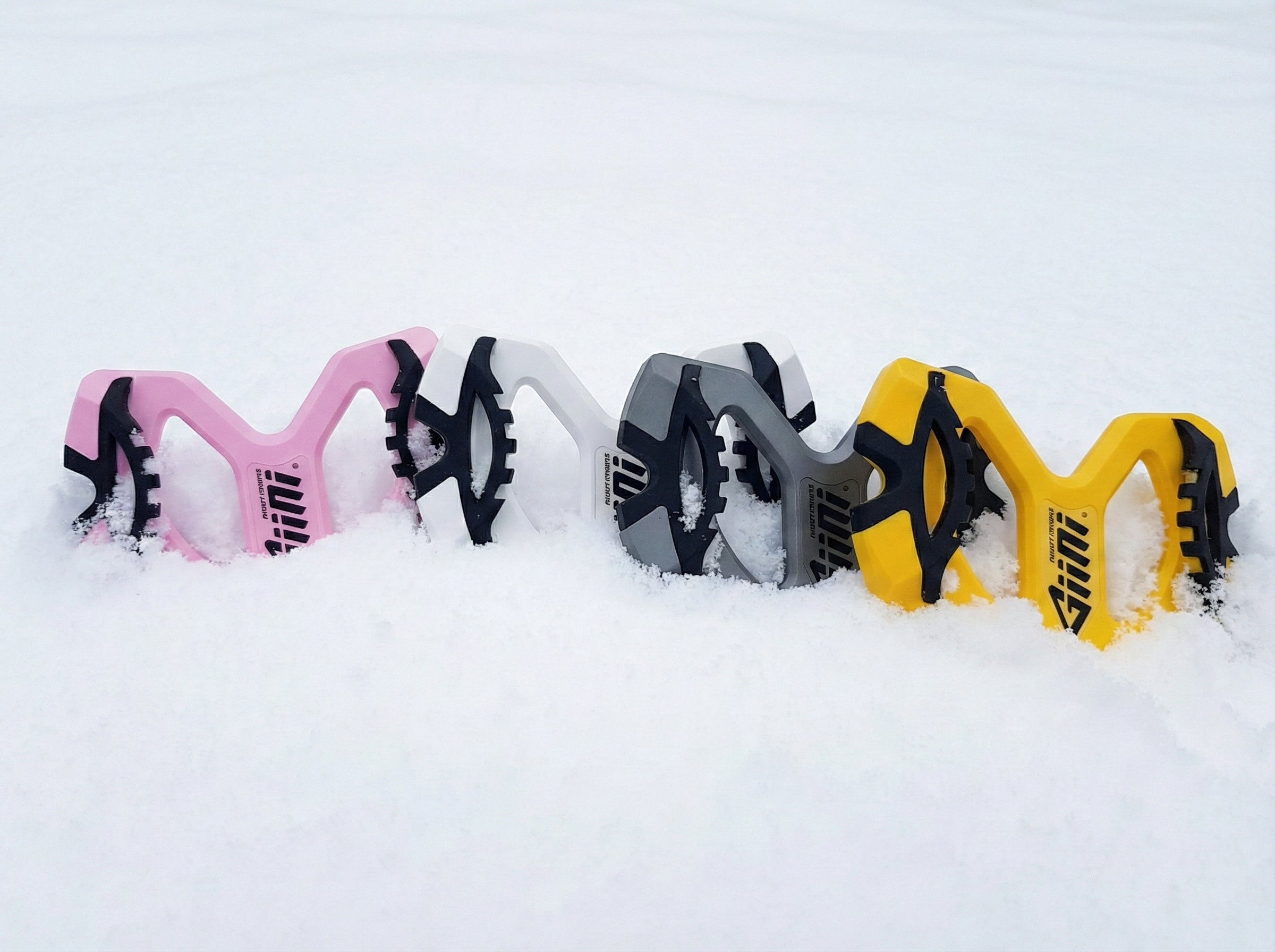
Pick up a Giini Pyro and you will notice what is missing. No screws holding the rubber in. No clips, no levers, no tiny parts waiting to disappear into the snow. The bumpers are held in place by shape alone, and that shape has a name: FlexLok.
Geometry doing the work of hardware
Each rubber bumper has wings that slot into the frame, with small nodules that seat into matching pockets along the frame's edge. Our founder Andrew Gillespie calls those pockets garages, which tells you how he thinks about it: every part of the bumper parks somewhere specific. Slanted walls above the wings stop the bumper lifting or working loose under normal riding, no matter how much your boot rubs and torques against it.
"It's just the engineering," Andrew says. "The geometry, the interlocking faces, they're designed to keep it in place. I want to make this easy for riders. It's not rocket science. It doesn't have to be difficult."
Designed to let go, on purpose
Here is the clever part. If you fall awkwardly and twist, the bumpers are designed to pop out rather than break. You pick them up, flex them back into their garages with your thumbs, and you are riding again. No tools on a chairlift, no warranty claim, no dead product.
The bumpers are also the wear part of the system, like tires on a car. Rubber gripping boot sidewalls all season will eventually wear, so the same geometry that lets them pop out safely lets you replace them in seconds when the time comes.
Why simplicity is the feature
Andrew's design rule is that a rider should never need a booklet to understand the product. Everything the Pyro does, it does through the shape of two parts meeting. Fewer parts, nothing to corrode, nothing to lose, and nothing between you and the lift line.