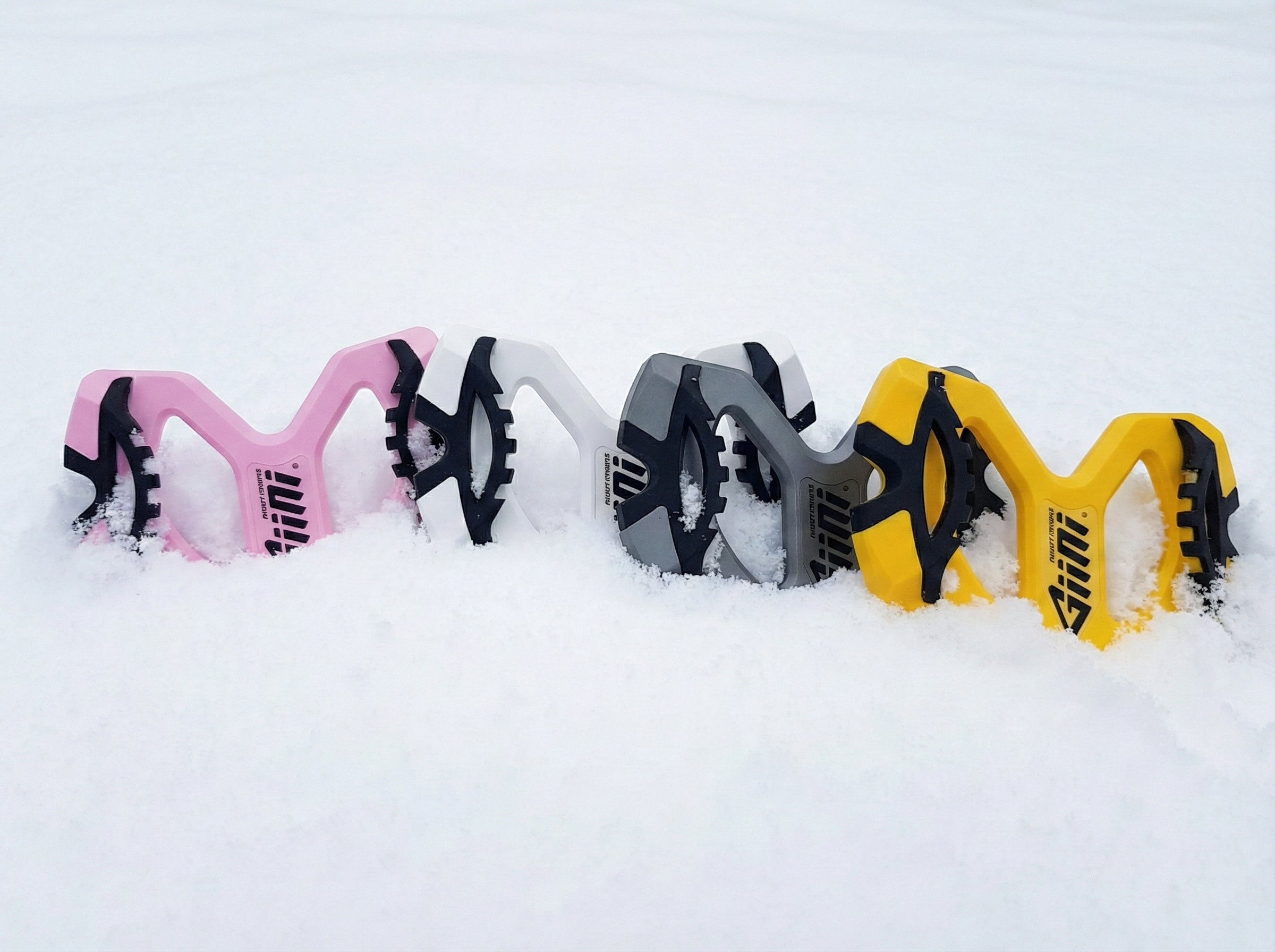
Good engineering has a tell: parts start disappearing. Where a first draft uses a spring, a fastener, a cover and a seal, the refined version often does all of it with one shape. The Giini Pyro's rubber bumper is that kind of part. It does four jobs at once.
Job one: grip
The bumpers grab the sidewalls of your boot the moment you step in. Not the sole, the sidewalls. That is what turns downward pressure into actual steering, because the board now follows your foot sideways, which is the direction turning happens.
Job two: spring
Openings in the bumper walls let the rubber flex and load like a spring, so your boot is being actively squeezed, not just parked. Early prototypes used solid bumpers with ridges. Testing showed that opening the walls up gave far more gripping force from the same material, using nothing but geometry.
Job three: shed
Chamfered surfaces around every edge push snow and ice out as your boot slides in. This is the job most people never think about, and it is the one that kills the stomp pad category: any texture that can hold snow eventually becomes a skating rink. The Pyro is shaped so buildup has nowhere to live.
Job four: let go
Fall awkwardly and the bumpers pop out instead of breaking, then press back in by hand. A part that never yields is a part that snaps. This one knows when to quit.
The philosophy underneath
"There's nothing on there that is not necessary," says our founder Andrew Gillespie. "It's minimalist design." No screws, no clips, no manual. The whole product is two materials meeting each other in a very carefully argued way, and that argument took years of sketches and seasons of on-hill testing to win.