The Truth About Snowboard Traction
Most riders believe a $10 foam sticker is enough to keep them safe. It isn't. Standard stomp pads rely on friction, which requires contact between rubber and boot. The moment snow packs into the pad's texture, that contact is lost, and the pad becomes a slip-n-slide. The only reliable snowboard traction device is one that uses mechanical grip: physical barriers or active tension that lock the boot in, regardless of snow or ice buildup.
The "Anti-Slip" Checklist:
- Material: Avoid soft foam; look for rigid rubber or TPU.
- Mechanism: Choose mechanical locking (active tension) over surface texture.
- Profile: High-profile ridges clear snow better than flat studs.
- Adhesive: Industrial-grade VHB (Very High Bond) is non-negotiable.
- Fit: The device should cup or grab the boot, not just sit under it.
Table of Contents
- The Physics of Failure: Why Friction Dies in the Cold
- The "Sticker" Scam: Foam vs. Hardware
- The Solution: Mechanical Traction
- Comparison: Stomp Pads vs. Giini Pyro
- Frequently Asked Questions
The Physics of Failure: Why Friction Dies in the Cold
We need to talk about the coefficient of friction. In a dry environment, rubber on rubber grips well. That is why stomp pads feel great when you touch them in the snowboard shop.
But mountains aren't dry.
When you skate off a lift, your boot is covered in snow. As you step down, that snow is compressed into the grooves of your stomp pad. This creates a layer of water and ice between your boot and the board. Physically, you are no longer stepping on a traction pad; you are stepping on a layer of compressed ice.
A snowboard traction device that relies solely on surface texture is engineered to fail exactly when you need it most.
The "Sticker" Scam: Foam vs. Hardware
The industry has spent decades selling accessories that are essentially stickers.
Foam Pads: These act like sponges. They freeze, harden, and lose all grip properties in sub-zero temps.
Metal Studs: While they look cool, they offer minimal surface area. If you miss the stud by an inch, you slip.
Plastic Spikes: Better, but they wear down and become smooth over a single season.
If you are riding a $600 board with $300 bindings, relying on a $15 sticker for control is a math problem that doesn't add up. You don't need a sticker; you need hardware.
The Solution: Mechanical Traction
To fix the lift exit, we have to stop fighting physics and start using it.
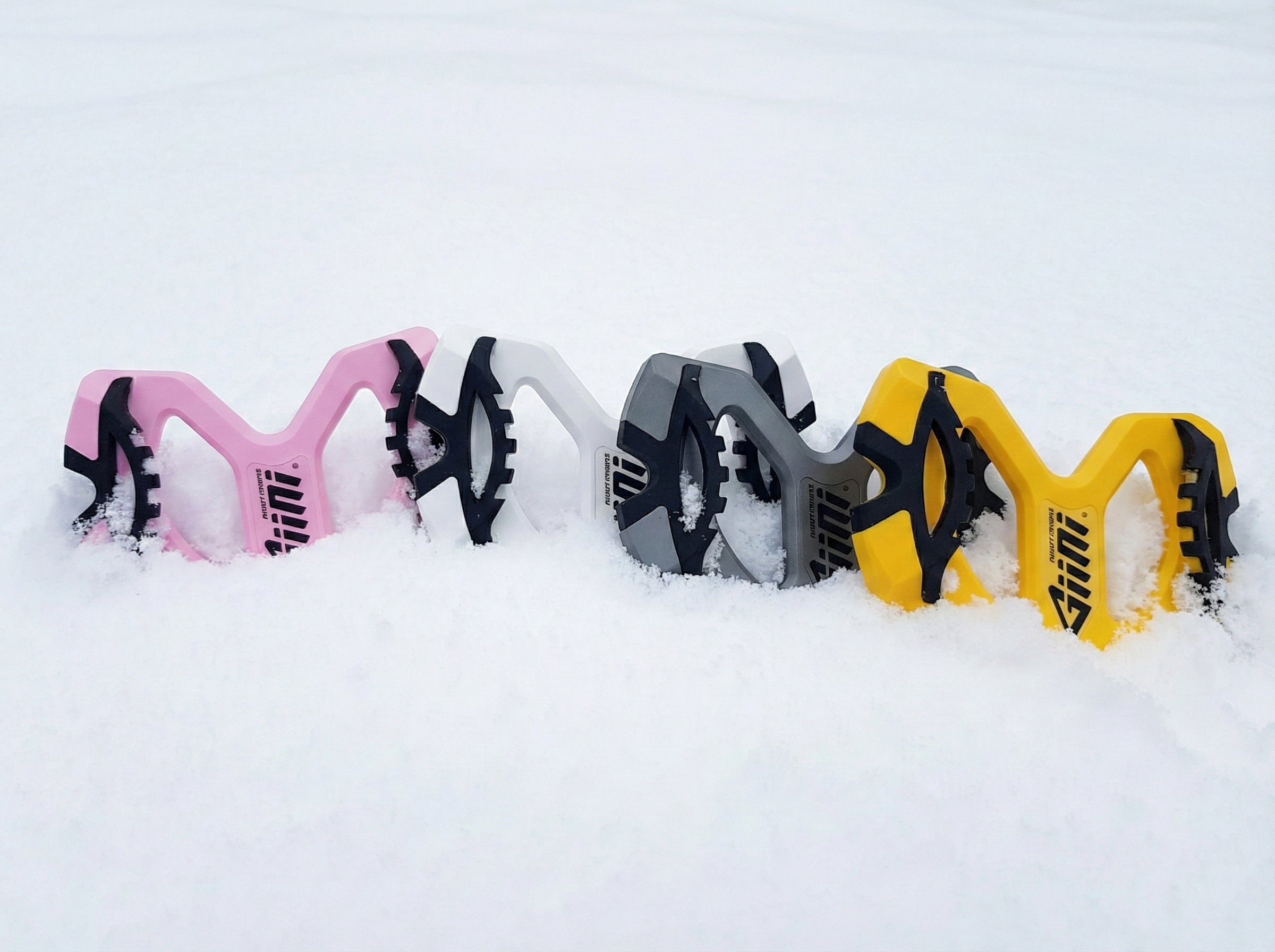
This is why we engineered the Giini Pyro. It is not a stomp pad; it is a dedicated snowboard traction device. Instead of hoping for friction, the Pyro uses Active Tension Technology.
- The Lock: Spring-loaded rubber bumpers expand when you step in, mechanically gripping the sidewall of your boot.
- The Snow Shed: The open-chassis design allows snow to pass through rather than packing in.
- The Leverage: Because the device grabs the side of your boot, you gain the ability to steer the board on its edge with one foot unstrapped, something a flat pad can never offer.
Comparison: Stomp Pads vs. Giini Pyro
| Feature | Traditional Foam Pad | Metal Studs | Giini Pyro |
|---|---|---|---|
| Grip Mechanism | Surface Friction | Point Friction | Active Mechanical Tension |
| Performance in Powder | Fails (Packs with snow) | Poor (Hard to find) | Excellent (Locks in) |
| Performance in Ice | Fails (Freezes over) | Moderate | High (Physical Barrier) |
| Steering Control | Low (Top-down pressure only) | Low | High (Sidewall leverage) |
| Durability | 1 Season (Peels/Rips) | High | High (Industrial Materials) |
Frequently asked questions
-
Do I really need a traction device on my snowboard?
Yes. Even advanced riders use them. The top sheet of a snowboard is glossy and slick. Without a traction device, attempting to skate through flat areas or unload from a chairlift is dangerous and creates a high risk of groin injuries or collisions.
-
Will the Giini Pyro fit my snowboard boots?
The Giini Pyro is engineered with a universal U-shape chassis designed to accommodate all standard adult snowboard boot sizes. The spring-loaded arms adjust to the width of the boot sole, ensuring a tight mechanical lock regardless of your boot brand.
-
How do I remove a snowboard traction device without damaging the board?
Heat is the key. Use a hair dryer (not a heat gun) to warm the adhesive bond. Once warm, use dental floss to saw behind the device and lift it off. Clean the remaining residue with a citrus-based cleaner or rubbing alcohol.
-
Where exactly should I install the device?
Install the device on the board's top sheet, directly next to the inside edge of your rear binding. It should be placed where your boot naturally lands when you take your foot out of the binding. Test the placement with your boot on the board before peeling the adhesive backing.
-
Why is my current stomp pad slippery?
It is likely "snow-packed." When snow fills the texture of a pad, it creates a hydroplane effect. Alternatively, if your pad is foam, it may have frozen solid, turning the soft grip material into hard, slick ice.
-
Is the Giini Pyro reusable on a new board?
The hardware transfers; the adhesive is single-use for maximum strength. If you buy a new board, you can remove the Pyro, apply a new strip of industrial VHB tape (available at hardware stores), and reinstall it on your new deck.